Ovech Fortress
A medieval stronghold above Provadia, inhabited from the fourth to the end of the seventeenth century.
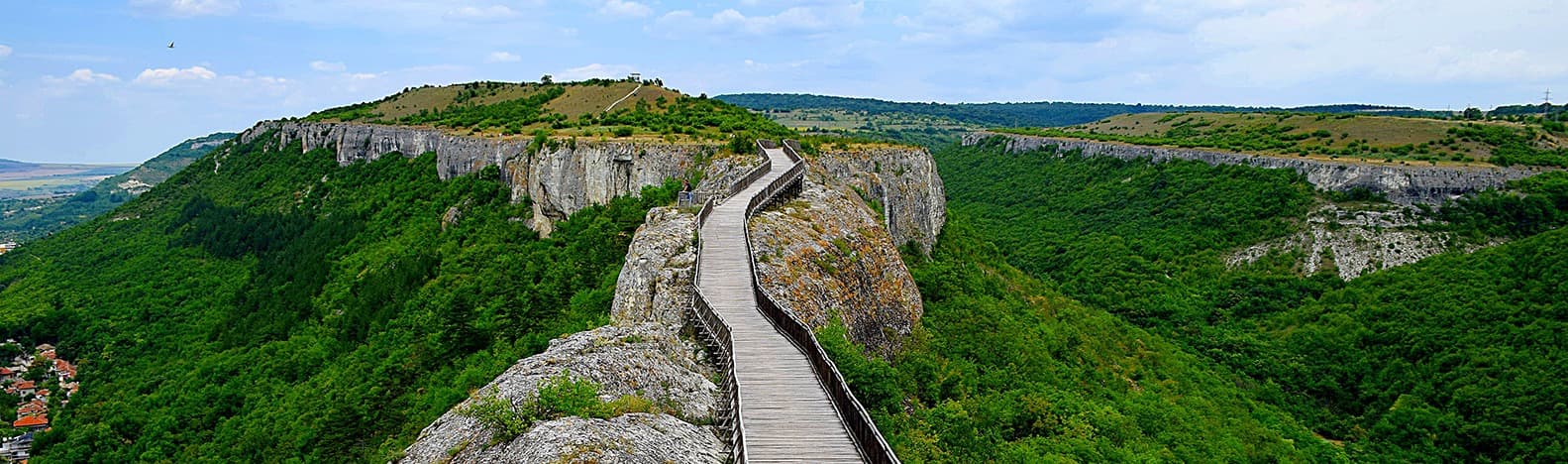
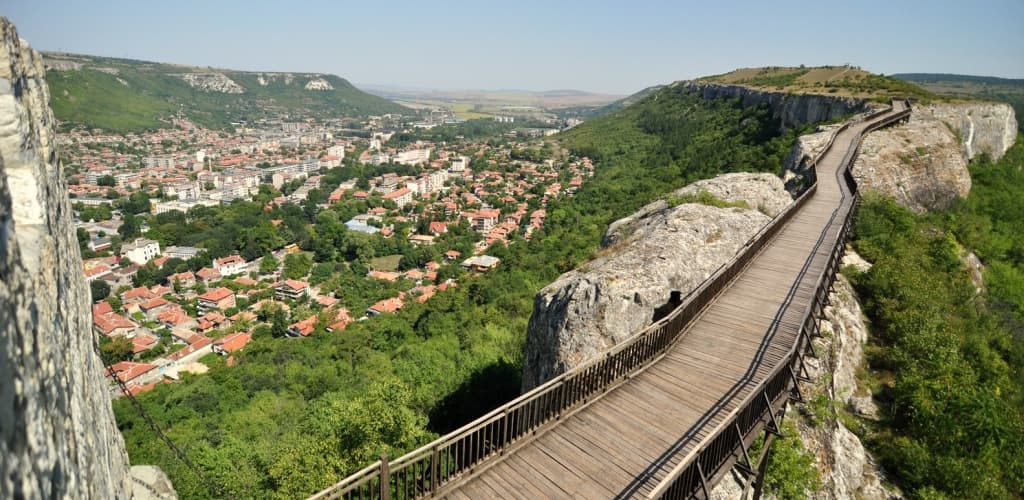
Ovech is a medieval fortress east of the present-day town of Provadia. It stands on a plateau above the town known as Kaleto.
Built by the Byzantines, the fortress was active from the fourth to the early seventh century, then stood unused for almost a century. Settlement resumed in the eleventh century and continued until the end of the seventeenth. Evidence also confirms a Thracian presence before the fortress was founded, although Ovech reached its greatest prosperity during the Second Bulgarian Empire.
One place, four names
- Provat · Provatonsheep fortressThe Byzantines
- OvechThe Bulgarians
- Tash Hisarstone fortressThe Ottomans
- BurphantaTwelfth-century chronicles
The plateau and gate
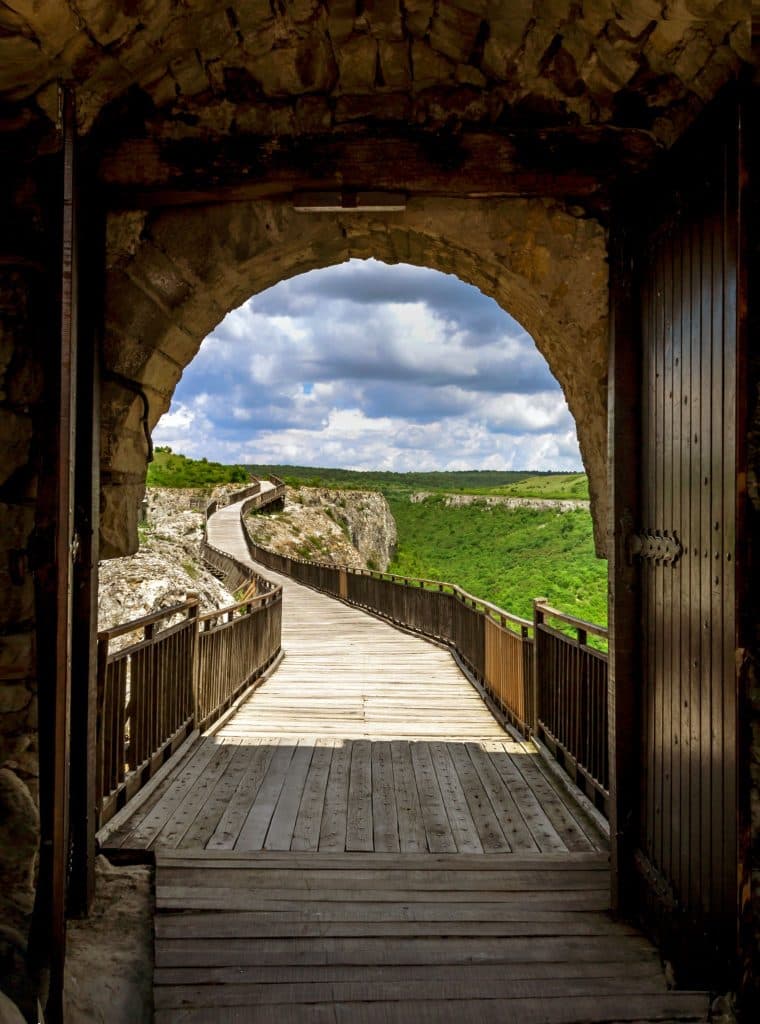
The fortress occupies a plateau shaped like a ship running north to south. It is surrounded on every side by rock faces between 11 and 25 metres high. A narrow isthmus joins it to the neighbouring Tabiyte plateau to the north. High defensive walls once rose across the northern part of Kaleto, where the stronghold’s Main Gate stands. A bridge approximately 160 metres long connected the gate to the Tabiyte isthmus. A drawbridge crossed an artificial cutting in front of the gate, eight metres long and five metres deep.
Immediately beyond the Main Gate, a road cut into the rock and vaulted for more than ten metres leads into the fortress. Legends tell of vast stores of grain and food kept in the karst caves beneath the stronghold to sustain the town’s inhabitants during a siege.
Defending the capitals
One reason Ovech developed so strongly under Bulgarian rule was its relative proximity to Varna. Bulgaria did not possess a powerful navy capable of opposing the Byzantine fleet, making Varna vulnerable to attack from the sea.
Ovech was therefore developed as an outpost protecting Bulgaria’s medieval capitals from a Byzantine advance.
What remains today
- the fully restored bridge between the fortress and the Tabiyte plateau
- numerous wells for collecting water, including one 80 metres deep
- grain cisterns
- the ruins of a three-nave, single-apse church — centre of the Diocese of Ovech
- two single-nave, single-apse churches from the twelfth to fourteenth centuries
- watchtowers
- the stone northern gate
- prisons for nobles, convicted townspeople and prisoners of war
- the marble columns of Omurtag
- caves inhabited since antiquity
Chronology
Fourteen centuries on the plateau
- 4th–7th c.
Byzantine period
Provat is thought to have been founded as a Byzantine frontier fortress against warlike tribes advancing from the north. It was named Provaton, Greek for ‘sheep fortress’. Asparuh’s Bulgarians adopted the literal translation already used by the Slavs, and Bulgarian records consistently call it Ovech.
Initially built for defence, it quickly became a major administrative and military centre with a permanent population. Sources describe the fortress as a regional administrative centre and, after Bulgaria’s conversion to Christianity, an episcopal seat. A substantial military garrison was also stationed in the town.
- almost a century
The fortress was inactive after the beginning of the seventh century.
- 9th c.
First Bulgarian Empire
Although firm evidence is lacking, Ovech probably existed during the First Bulgarian Empire. Two inscriptions of Khan Omurtag have been discovered, commemorating military commanders who died during his campaigns against the Franks and Magyars.
- 12th–14th c.
Second Bulgarian Empire
The fortress was used by Tsar Kaloyan and his brother Peter II.
In 1278, two Byzantine armies of 5,000 and 10,000 soldiers attempted to cross the Balkan Mountain passes towards Tarnovo. Led by the generals Aprin and Murin, they were destroyed by the warriors of Tsar Ivaylo. The next Byzantine commander, Michael Glabas Tarchaneiotes, tried to advance through Varna. After taking several fortresses in the eastern Balkans, he was halted at Ovech. While he laid siege, Ivaylo’s army arrived behind him and eliminated the Byzantine force within days. Michael Glabas, himself thought to have been of Bulgarian origin, cited ill health and sailed for Constantinople, leaving his soldiers without a commander.
In 1366, on the orders of Tsar Ivan Alexander, three knights of Count Amadeus VI of Savoy were imprisoned at Ovech. One was the Marshal of Burgundy, Guido di Pontharlier. They had been captured by troops from Ovech after taking part in the fighting at Galata. The nobles were released following the intervention of the Catholic Patriarch of Constantinople in exchange for a ransom of 2,400 gold perpera.
- 1388–17th c.
Ottoman rule
Ovech fell to the Ottomans in 1388 before an army of 30,000 commanded by Lala Şahin. The army entered by deception at night after a truce had been agreed. The Ottoman chronicler Neşri wrote that the defenders recovered and resisted fiercely, while the Ottoman force also suffered terrible losses.
In 1409 Ovech became the centre of an uprising led by Fruzhin, son of Ivan Shishman. Musa, son of Bayezid I, retook the fortress in 1413 and dealt harshly with the rebellious population. The forces of the Polish-Hungarian king Władysław III of Varna attacked in 1444 and razed the fortress.
After Władysław’s defeat at Varna, the Ottomans returned but retained only a small garrison. The stronghold gradually lost its purpose. It was maintained until the end of the seventeenth century, when the Bulgarian lands had become a deep hinterland of the empire and the fortress was abandoned. Its Bulgarian population founded the present-day town of Provadia.